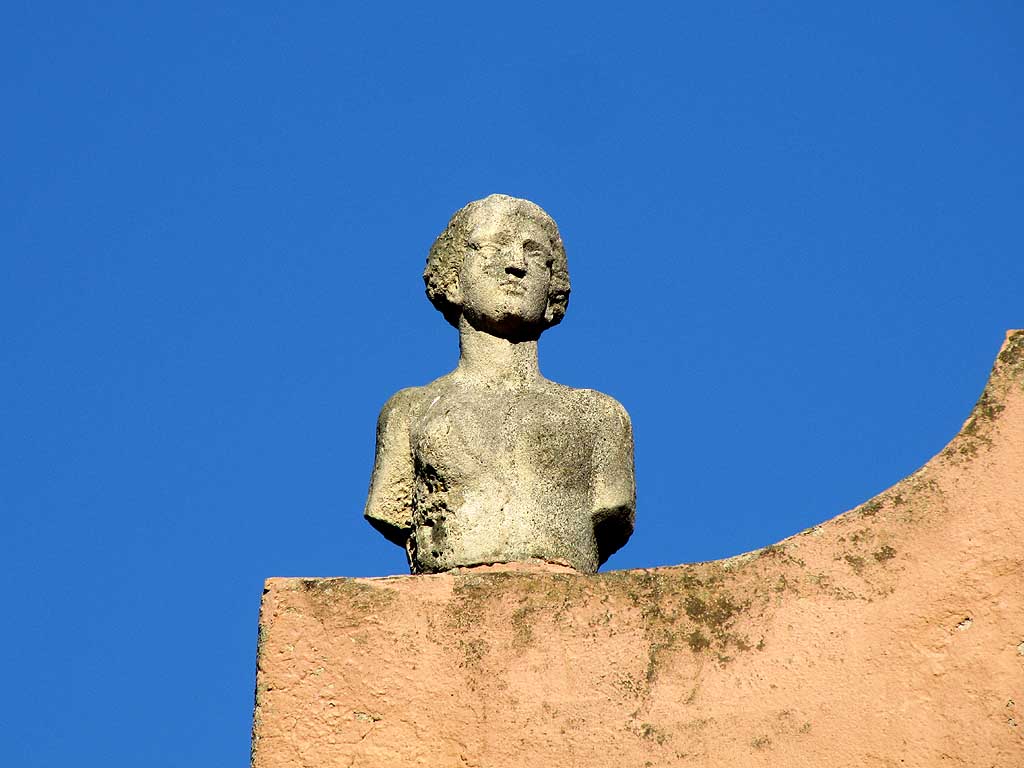
Qualcuno ha abbandonato il busto di Amedeo Modigliani sul marciapiede di via Marradi.
 Please put it back where it belongs...
Per favore rimettetelo dove dovrebbe stare...
 Please put it back where it belongs...

 |  |
| Enrico Mayer (1802-1877) Pedagogist and writer | Angelica Palli (1798-1875) Writer |
 |  |
| Carlo Bini (1806-1842) Writer and patriot | Enrico Pollastrini (1817-1876) Painter |
 |  |
| Giuseppe Orosi (1816-1875) Chemist | Francesco Bonaini (1806-1874) Philologist and palaeographist |
 |  |
| Francesco Domenico Guerrazzi (1804-1873) Politician and writer | Vincenzo Malenchini (1813-1881) Soldier and politician |


 The bust of the respected politician Giuseppe Emanuele Modigliani and the one of his brother, the world famous painter Amedeo Modigliani, are placed on different sides of the “Villa Fabbricotti” building. For once, we are pleased to reunite them...
 Guglielmo Oberdan thinks: “I was a patriot and a martyr, but after 130 years I am tired of wearing a hangman's noose!”
 Amedeo Modigliani got a quite good location for his bust, at the end of the main avenue inside the park of “Villa Fabbricotti”.
 A few steps on the right, the poor Pietro Mascagni wasn't so lucky, he feels dirty and is overwhelmed by the graffiti in background.
 Giuseppe Garibaldi, a statue by the sculptor Augusto Rivalta.
 A bust (which is not a statue) of Giuseppe Mazzini, now sadly hidden inside the “Fortezza Nuova”, closed to public since January 2009
 Last week, in a comment, Julie of Sidney Eye asked me why there aren't preminent female figures in the statues and monuments of Livorno. I checked on books and lists and found a lonely statue inside our Library in “Villa Fabbricotti”, but something else I read made me blush.


 The “Sacro Cuore” (Sacred Heart) is the church of the Salesian compound. It was built after the First World War in the new quarter of the Stazione (Railway Station) by the architect Torello Macchia and consecrated in 1928. In 1932 the church became a regular Parish of the Diocese of Livorno and is commonly known as “I Salesiani” (The Salesians).
 The church has no bell tower but only what is called in Italian a “campanile a vela” (literally sail-shaped belfry). I don't know the equivalent English architectural term: I have found that in French is campenard and in Spanish espadaña.
 A bust of Don Tommaso Masera, the founder of the “Opera Salesiana” in Livorno, is placed in a small garden on the side of the church.
 This is a quiz, but I do not know the answer. In the park of “Villa Fabbricotti” near a building which hosts the “Biblioteca dei ragazzi” (Children's Library) you can find these statues, partially hidden in a secluded spot.
 I remember them from when I was a boy prowling the park and snubbing the library. After few years and many books I learned that they represented the Three Musketeers, which obviously were four.
 Inside the park there are statues of the likes of Modigliani, Mascagni, Carducci, but these four were the only I knew and I cared for. These are not great work of art, but this was and is beyond my interest.
 What about the quiz? I simply can't remember which statue represent each one of the Musketeers. I could easily place one, maybe two, but I'm not sure. Anybody willing to help?Amedeo Modigliani was born on July 12, 1884, when Livorno was a thriving commercial port and also a refuge for those persecuted for their religion. His great-great-grandfather was a Jew who had immigrated to Livorno in the 18th century as a religious refugee. His father Flaminio, a money-changer, went bankrupt, forcing his family to live in poverty. Amedeo's birth probably saved the family from certain ruin because an ancient law stated that creditors could not seize the bed of a pregnant woman or a mother with a newborn child. When bailiffs entered Modigliani's home, with his mother Eugenia just into labour, the family piled their most valuable assets on top of her's bed, saving most of them.
 The bust in the first photo is placed at the main entrance of Villa Fabbricotti, a park which also hosts the main local library. The plaque is outside the still existing house in Via Roma, now a private museum, and says:
 As a matter of fact the Livornesi eat their Cs. It is part of a phonetic phenomenon called Tuscan gorgia which, in very simplistic terms, substitutes some Cs in a word with nothing. A phrase that still awes outsiders is the anecdotic local rendition of “Coca-Cola con la cannuccia” (Coca-Cola with a straw), which would sound something like this: “òa-òlah òla annoochah”, killing five Cs in a row. Giuseppe Mazzini (1805-1872) was a patriot and philosopher, whose efforts helped bring about the modern Italian state. Here is a bust dedicated to him by “Livorno repubblicana” (Republican Livorno) in the square carrying his name. And, as you can see, somebody ate the C of “repubblicana”.
 Wilhelm Oberdank, who italianicized his name to Guglielmo Oberdan, was an Italian irredentist executed in 1882 after a failed assassination attempt on the Emperor Franz Joseph of Austria.