The back of the synagogue is decorated with five sets of 32 small triangular windows. Their effect is visible in the pictures taken inside the temple, while their number may also have some kabbalistic meaning.
See also: Synagogue of Livorno - Inside the Synagogue - Rejoicing of the Law - The Old Synagogue - Around the Tebah - The Doors of the Synagogue
External links: Kabbalah and the 32 Types of Consciousness (The Huffington Post)
Search labels: synagogue
Showing posts with label synagogue. Show all posts
Tuesday, April 1, 2014
Monday, March 3, 2014
The Doors of the Synagogue
Our synagogue has three entrances, every one marked with a Jewish symbol. The left one has a Menorah, we are going to see the other two with the help of our friend Dina, of Jerusalem Hills daily photo.
Above the central door we can see the luchot habrit, the tablets of the covenant. On the right one are the letters alef, bet, gimel, dalet, heh. The letters of the Hebrew alphabet can also be also be numerals, so we have First Commandment, Second Commandment, and so on. It continues on the left tablet with the letters vav, zayin, chet, tet, yod: the Ten Commandments.
The lettering around the star of David, from right to left, says Kadosh la Adonai, meaning “Holy unto God”. The final letter, heh, is a way of writing God's ineffable name without writing it.
External links: Menorah - Tablets of Stone (Wikipedia)
See also: Synagogue of Livorno - Moses Montefiore - Inside the Synagogue - Rejoicing of the Law - The Old Synagogue - Around the Tebah
Search labels: synagogue
Sunday, October 28, 2012
Around the Tebah
Should we take it as a compliment if our top daily paper by circulation publishes a picture lifted from our blog? Sadly neither due credits nor acknowledgements are in sight, at least on the webpage. I have sent several pictures to this paper in the past and they almost always ended up with the proper author quoted alongside.
The problem arises from the fact that this photo was posted only on this blog, in February 2011, and it was never sent to anybody. How did it end up in the newspaper slideshow for the 50 years of the new synagogue of Livorno? A simple slip-up? An anonymous sender of someone else's pictures?
Search labels: synagogue
See also: Synagogue of Livorno - Rejoicing of the Law
The problem arises from the fact that this photo was posted only on this blog, in February 2011, and it was never sent to anybody. How did it end up in the newspaper slideshow for the 50 years of the new synagogue of Livorno? A simple slip-up? An anonymous sender of someone else's pictures?Search labels: synagogue
See also: Synagogue of Livorno - Rejoicing of the Law
Sunday, August 19, 2012
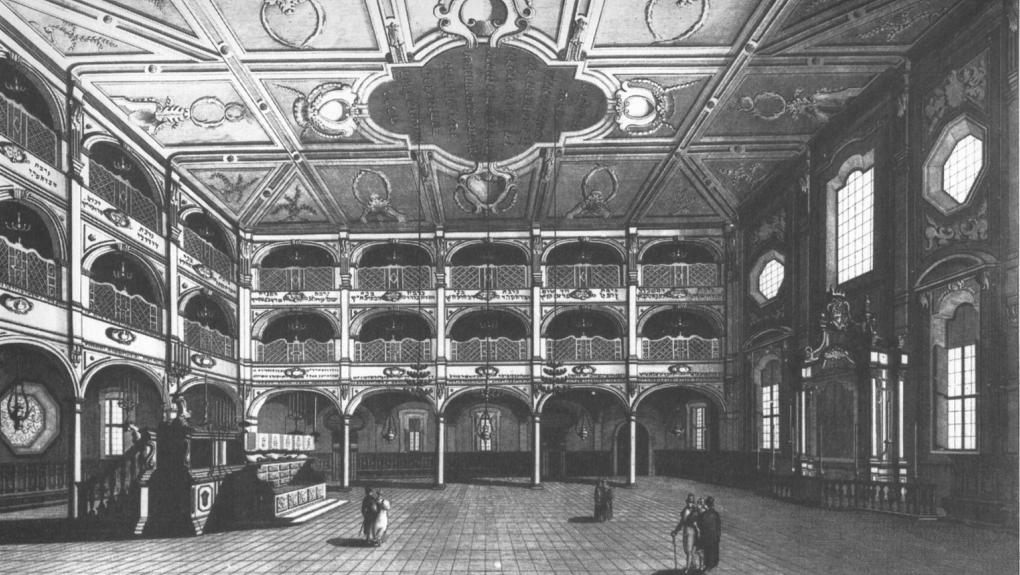
The Old Synagogue
The facade of the old synagogue of Livorno, destroyed during Allied air raids in the Second World War.
The tebah, the pulpit from where the Torah was read. Part of the balauster was salvaged and was used for the same purpose in the new synagogue.
The Torah ark, which contained the Torah scrolls of the synagogue.
A frontal view of the tebah, you may compare it with this 1850 painting by Solomon Hart.(1905 postcards digitized from the collection of Antonio Cantelli)
Search labels: synagogue
See also: Synagogue of Livorno - Inside the Synagogue - Moses Montefiore
External links: Tebah - Torah ark
Sunday, February 13, 2011
Rejoicing of the Law

The Feast of the Rejoicing of the Law at the Synagogue in Leghorn (Livorno)
1850, oil on canvas by Solomon Alexander Hart (1806-1881)
The Jewish Museum, New York
1850, oil on canvas by Solomon Alexander Hart (1806-1881)
The Jewish Museum, New York
Using one of the artist's few observations of a Jewish structure during his Italian tour, the work shows the interior of the magnificent synagogue in Leghorn, originally built in 1591.
This interior is perhaps the foremost example of the lavish redecoration common to Italian synagogues in the eighteenth century. Hart captures a romantic vision of the exotic dress of his Italian coreligionists as they parade the scrolls of the Law on Simhat Torah, the feast of the rejoicing of the Law.
This marks the end of the fall harvest festival, Sukkot, and is the holy day on which the yearly cycle of reading the Pentateuch ends, immediately beginning again with Genesis.
(Masterworks of the Jewish Museum, New York, 2004)
The old synagogue was destroyed in the Second World War, but some of its balusters survive in the tebah of the new one.See also: Synagogue of Livorno - Inside the Synagogue - Moses Montefiore
External links: The Jewish Museum, New York
Search labels: synagogue
Wednesday, January 26, 2011
Geometric Walk
Yellow grille shutter, “Via Mentana”.
The clock of the Cathedral.
Awning of the bar “Giubbe Rosse” (Red Coats), “Piazza Grande”.
The windows of the Synagogue.
A window seen from an opening of the porticoes in “Via Cairoli”.More Walks
Monday, September 6, 2010
Inside the Synagogue
This Sunday the Synagogue of Livorno was open to the public for the European Day of Jewish Culture.
The band of our “Accademia Navale” played the national anthem and the European anthem, based on Friedrich Schiller's Ode to Joy from the final movement of Beethoven's 9th Symphony.
A concert was held by the Chorus of the Great Synagogue of Rome in honor of Rome's chief rabbi emeritus, the Livornese Elio Toaff. In background the exquisite baroque Aron Kodesh (Torah ark), a 1708 masterpiece from the Synagogue of Pesaro.
The chorus was lead by the maestro Claudio Di Segni, a tenor and a teacher at the “Accademia Nazionale di Santa Cecilia”.
At the end of the concert the chorus and the soloist sang a version of the “Hatikvah”.See also: Synagogue of Livorno - Moses Montefiore
Search labels: synagogue
Tuesday, May 18, 2010
Moses Montefiore
This is the Montefiore Windmill, which is not in Livorno but in Yemin Moshe, an old neighborhood in Jerusalem. The windmill was funded by the British Jewish philanthropist Moses Montefiore, who devoted his life to promoting industry, education and health in the Holy Land.Moses Montefiore may be rightly considered British but he was surely born in Livorno in 1784, where he began his career as an apprentice to a firm of grocers and tea merchants.
A pair of plaques commemorate him on the wall of the community building, next to the Synagogue.

To the perpetual remembrance
that on 24 October 1784 here was born
Sir Moses Montefiore
in Syria, Russia, Morocco, Romania
tireless apostle of tolerance
to any kind of misfortunes
without distinction of country or persuasion
widely merciful
Died in Ramsgate on 28 July 1885
Honored by the powerful blessed by the poors
Plaque recovered from the nearby house
where Sir Moses Montefiore was born
Placed here on 21-2-1965

One hundred years after the end
of the long and full life
be blessed the memory
of Sir Moses Montefiore
27 October 1985
12 Cheswan 5746
World Sephardi Federation
of the long and full life
be blessed the memory
of Sir Moses Montefiore
27 October 1985
12 Cheswan 5746
World Sephardi Federation
See also: Synagogue of Livorno - Inside the Synagogue - Rejoicing of the Law
Thursday, May 13, 2010
Via Cairoli
We have seen in several posts the area around “Piazza Cavour”.“Via Cairoli” joins “Piazza Cavour” with our other main square “Piazza Grande”, reaching the apse of the Cathedral where, before the last war, there was a beautiful fountain.
It takes its name from the Cairoli brothers (Benedetto, Ernesto, Luigi, Enrico, Giovanni) who fought and fell in the wars for the Italian unification. Benedetto, the only surviving brother, became a respected politician and statesman.
Before 1784 the street was called “Via delle Quattro Cantonate degli Ebrei” (Street of the Four Corners of the Jews) because, at the time, most of the Jewish families lived in the area at the intersection with “Via del Tempio” (Temple Street), leading to the Old Synagogue. The above picture is taken just from that point, “Via del Tempio” is the street on the left, now leading to the new Synagogue, while in the middle we see the apse of our Cathedral.
From the apse of the Cathedral looking back to “Piazza Cavour”.See also: Piazza Cavour - Duomo of Livorno - Synagogue of Livorno
External links: Jewish community of Livorno
Sunday, May 17, 2009
Synagogue of Livorno
The first synagogue in Livorno was built around 1606 between the Cathedral and the Fosso Reale, then enlarged and embellished in various stages until 1789.
The temple suffered heavy damages during the last war, so the jewish community of Livorno decided to build a new synagogue rather than restore the old one.
The new synagogue was built in 1962 in the same place, in a square now named after Elijah Benamozegh. The jewish architect Angelo Di Castro (blacklisted under the fascist racial laws) designed a tentlike building, following the outlines of the original Tabernacle.
Elio Toaff, Chief Rabbi of Rome for fifty years, was born in Livorno in 1915 and is probably the most famous son of this community in recent times.See also: Inside the Synagogue - Moses Montefiore
Search labels: synagogue
Labels:
architecture,
building,
Livorno,
synagogue
Subscribe to:
Posts (Atom)


