The entrance of the former villa Tommasi, now a private school run by the Mantellate sisters, Via Bonomo.
L'ingresso dell'ex villa Tommasi, ora una scuola private gestita dalle suore Mantellate, via Bonomo.
Window and part of the gate, Villa Regina Park, Borgo dei Cappuccini. (Already posted on Instagram)
Finestra e parte del cancello, Parco di Villa Regina, borgo dei Cappuccini. (Già pubblicato su Instagram)
One of two dogs guarding a gate in Via dell'Ambrogiana. (Already posted on Instagram)
Uno di due cani di guardia ad un cancello in via dell'Ambrogiana. (Già pubblicato su Instagram)
A detail of the Saint Mark's Gate, Piazzale Undici Maggio. (Already posted on Instagram)
Un dettaglio della Porta San Marco, piazzale Undici Maggio. (Già pubblicato su Instagram)
A monogram on a gate in Via Borsi. What letters do you see? An A and a T? Or a J? (Already posted on Instagram)
Un monogramma su un cancello in via Borsi. Che lettere ci vedete? Una A ed una T? O una J? (Già pubblicato su Instagram)
The cast iron vault of Porta San Marco (Saint Mark's Gate). This structure, built by the architect Carlo Reishammer in 1840, is the only gate still standing after the demolition the Leopoldine Walls. (Already posted on Instagram)
The “chiesa della Santissima Trinità” (church of the Most Holy Trinity) in “Borgo dei Cappuccini”.
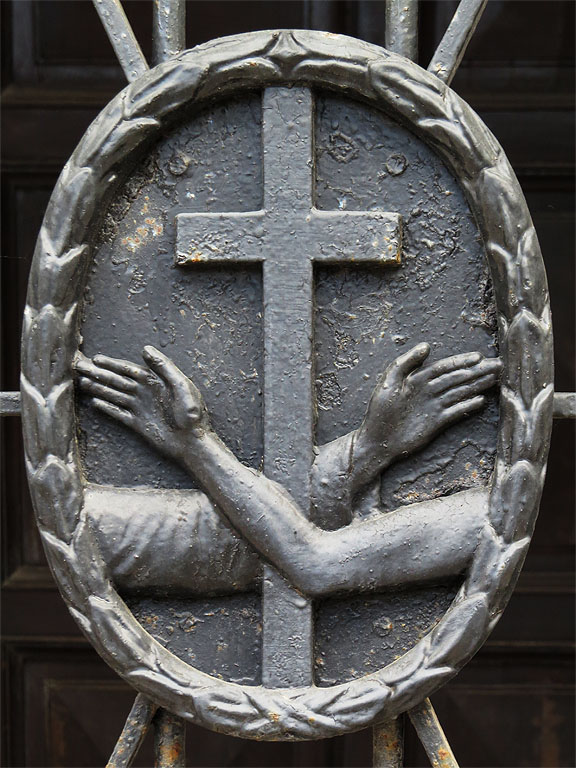
The symbol of the Franciscan Order on the gates of the church. This 1982 sundial celebrates the six centuries of the presence of the Order in Livorno. By the way, if adjusted for DST, the time was right.
People keep talking about promotion of tourism as part of local economic development, but a look at the sorry state of Porta San Marco (Saint Mark Gate) and of many other historical landmarks is not encouraging.
These gates may not be identical twins, but I am quite sure that at least their decorations are related closely. The dark one is in Via Antonio Pacinotti and it looks quite pristine. The second gate is in Via Roma and it is probably missing the central part. We have already seen it a few months ago about its hippogriffs.
The recently restored gate of the Parterre, now Sandro Pertini park. The pillar in background is what is left of a monumental fountain once placed at the corner of Via Garibaldi with Via Galilei. The statue on the top represents Hygieia, the goddess of health. On the body of the column we can find other symbols.
A hippogriff is a legendary animal that has the foreparts of a winged griffin and the body and hindquarters of a horse. His “inventor” was Ludovico Ariosto in his “Orlando furioso”. Within the poem, the hippogriff is extremely fast, can fly around the world and also to the moon: riding this creature the wandering knight Roger is able to free the beautiful Angelica.
Our hippogriff is one of a pair decorating an old gate in Via Roma.